
This is a hypothetical scenario. The firm is fictional. But the mismatch between what its insurance application said and what its systems could show is the kind now surfacing in real claims across the DMV.
The firm in this story is a fifteen-person accounting practice that has served the same group of regulated clients across Northern Virginia for well over a decade. It has a solid local reputation, a stable client base, and an IT history so uneventful the partners considered it a strength. Nothing had ever gone wrong, until an ordinary morning when someone in the office opened an email that looked like a routine message from a vendor the firm had worked with for years. Phishing remains the most reported form of cybercrime tracked by the FBI’s Internet Crime Complaint Center, well ahead of every other category, and this particular email did exactly what most of them are built to do. It captured a login.
Within a few hours, whoever was behind that email had used the stolen credentials to browse a shared drive holding client tax files. The firm’s monitoring flagged the unusual activity and cut off access before any files left the network and before any ransom demand arrived. No client was ever notified, because no client data was confirmed taken. The partners, understandably, felt like the story had a good ending.
The claim that came back with questions
The firm filed a claim with its cyber insurer to cover the incident response costs, things like forensics, credential resets, and a full review of what the intruder had touched. The claim crossed a size threshold that triggers a closer look before payout, which is standard practice at that level and does not, on its own, signal a concern about the business. The adjuster came back with three requests. The firm needed to show how far multi-factor authentication extended in practice, since the renewal application had described it as enforced across all critical systems. It also needed backup test logs from the past year, along with a copy of its documented IT policy.
Cyber insurers have spent the past few years moving away from taking application answers at face value, largely because too many of those answers described what a firm intended to have in place, when the running systems often fell short of the description. A claim large enough to warrant a second look is exactly where that shift plays out.
Where the application and the environment parted ways
The firm couldn’t produce a clean answer to any of the three requests. Multi-factor authentication turned out to be active on email only. Research from Marsh McLennan’s Cyber Risk Analytics Center has found that MFA only meaningfully lowers the odds of a successful attack when it covers all critical systems, all remote access, and every administrator account. Coverage limited to a single inbox doesn’t come close to the protection the application had implied.
A pattern was already forming. The parts of the environment nobody had checked in over a year turned out to be exactly the parts that mattered most once a claim was on the table. Backup testing hadn’t been logged in fourteen months, well past what CISA recommends. The agency’s guidance on ransomware and data extortion prevention calls for regular testing of both the availability and integrity of backups, and the silence left the firm with no way to show its restore process worked. A documented IT policy, the kind that spells out who can access what, how people join and leave the firm, and how an incident gets reported, didn’t exist at all. What ran the firm’s day-to-day security instead was institutional memory that nobody had reviewed and nobody had written down. The insurer flagged the MFA discrepancy as a possible misrepresentation on the original application, which put the size of the payout at risk, and then the payout itself.
The one record that changed the outcome
One control had, almost by accident, been handled properly the entire time. Patch management ran on an automated schedule that had been logging every update for two years straight, mostly because whoever set it up years earlier had configured it well and nobody had touched it since. Marsh McLennan’s research also found that patching high-severity vulnerabilities within seven days of release cuts the odds of an incident roughly in half, yet fewer than a quarter of the organizations in its study were managing that turnaround. This firm, without realizing it, had been in that smaller group the whole time, with two years of timestamps to prove it.
That single intact record, combined with how quickly the firm corrected everything else once the review surfaced it, changed how the insurer read the situation. The adjuster treated the missing controls as an oversight the firm was actively correcting, not a deliberate misstatement. MFA was extended within weeks, a documented policy was drafted and signed off by the partners, and a backup testing schedule went on the calendar. The claim was paid, at a reduced scope tied to the costs the firm could fully document, and the firm now checks its own hygiene on a schedule instead of treating it as something to set up once and forget.
What insurers are already checking
What came up in this review is the same handful of things insurers are checking on claims like this one now, because a self-reported answer on an application stopped carrying much weight on its own a while ago. It comes down to multi-factor authentication across the environment (email, remote access, admin accounts and every critical system), a patch cadence with a log to back it up, backups you can prove work, endpoint detection across the full fleet, and a documented IT policy on file.
Here’s what would have kept the claim fully intact from day one:
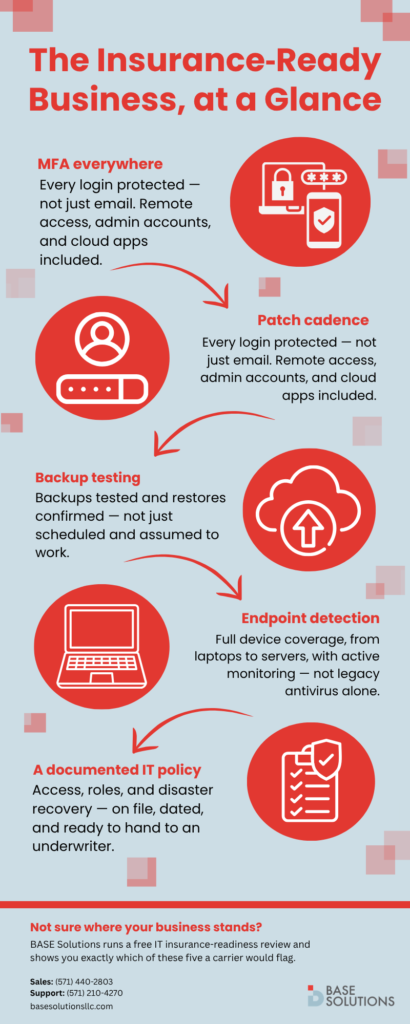
A firm that can produce all five when asked is demonstrating exactly the operational discipline insurers now price coverage around.
If this makes you wonder whether your own firm would pass the same review, that’s worth a conversation before your next renewal.