

Cloud computing has become essential for modern businesses. It allows companies to store data and run applications online, giving them flexibility and scalability they cannot get from local servers alone.
However, this shift to the cloud also creates new vulnerabilities. Unlike traditional IT setups, cloud environments are accessible over the internet and shared among many users, which exposes them to specific malware threats that exploit these traits.
Cloud malware targets these systems to steal data, disrupt services, or damage infrastructure. The rise in cloud malware attacks shows how attackers focus their efforts where they can cause the most damage. Over 80% of data breaches in 2023 involved cloud-stored data. These attacks can cause costly downtime and data loss that directly impact business operations and revenue.
Atul Bhagat, President/CEO at BASE Solutions, points out that “Cloud risks evolve quickly, and businesses must take proactive steps to defend themselves or face serious consequences.”
This blog explains cloud malware in depth, the types of attacks to watch for, and practical actions you can take to protect your business’s cloud data.
Shield Your Cloud Before Malware Slips In Through the Cracks
Stop threats before they hit. Let BASE Solutions secure your cloud with real-time protection and expert insight.
What is Cloud Malware and Why is it Dangerous?
Cloud malware is malicious software specifically built to attack cloud systems. These systems include data centers, virtual machines, applications, and cloud storage services. Unlike traditional malware that targets single devices or local networks, cloud malware targets the cloud’s unique structure.
Cloud environments share resources among many users and are accessible remotely, increasing the risk of widespread impact if a single vulnerability is exploited.
For example, an attacker might exploit a flaw in cloud management software to access multiple accounts or steal sensitive business information stored in cloud databases.
Since many businesses rely on cloud systems to run critical processes, an attack could halt operations, damage customer trust, or lead to regulatory penalties. The damage caused by cloud malware is often greater than traditional malware due to the scale and interconnectedness of cloud services.
The Most Common Types of Cloud Malware Attacks
Understanding the main types of cloud malware attacks helps you prepare the right defenses. Each type targets different weaknesses in cloud systems or user habits.
Here is a detailed look at the most common cloud malware attacks:
Injection Attacks
Injection attacks happen when attackers insert harmful code into cloud applications or databases through security gaps. These gaps often appear because software is outdated, improperly configured, or lacks proper input validation.
Once the malicious code is inside, it can run commands to steal data, corrupt information, or open hidden backdoors that give attackers ongoing access.
These attacks can spread quickly in the cloud because many users share the same infrastructure. This type of attack can cause serious damage to your cloud data and services if not stopped early.
- Patch management: Keep all cloud software and applications updated to close known security holes.
- Traffic monitoring: Use tools to detect unusual network activity that may signal an injection attack.
Phishing Scams in the Cloud
Phishing scams trick cloud users into revealing their login details by sending fake emails or messages. These emails look legitimate and ask users to click links or enter passwords on phishing websites.
Since cloud services rely on usernames and passwords, attackers who steal these credentials can gain full access to sensitive systems. This access can lead to data theft, unauthorized changes, or service interruptions. Phishing attacks succeed mainly because employees are not trained to spot fake messages.
- Two-factor authentication (MFA): Requires users to confirm their identity with a second step, such as a text code or app notification.
- Employee training: Security awareness training has significantly reduced phishing susceptibility for 80% of organizations. Teach staff to recognize suspicious emails and avoid clicking unknown links.
Data Corruption and Theft
Cloud malware can corrupt your business data by changing or deleting important files. It can also steal sensitive information like customer records, financial data, or intellectual property.
This can happen if attackers exploit weak access controls or if malware sneaks into your cloud storage. The loss or theft of data can disrupt your business operations and damage customer trust. Recovering lost or corrupted data can be expensive and time-consuming.
- Access control: Limit who can view or change sensitive data based on job roles.
- Activity monitoring: Track data access and file changes to spot suspicious behavior quickly.
Trojans Disguised as Legitimate Software
Trojans account for 58% of all known computer malware. Trojans are malware hidden inside software that looks safe and trustworthy. Attackers hide harmful code inside apps or tools that businesses download for cloud use.
When installed, this malware allows attackers to control cloud systems remotely or steal data without raising suspicion. Trojans can be difficult to detect because they appear as normal software to users and security systems.
- Download from trusted sources: Only install software from verified vendors and official app stores.
- File verification: Scan all downloads with security tools before installation to catch hidden malware.
Credential Bypassing Attacks
Credential bypassing occurs when attackers find ways to get into cloud systems without using normal login methods. They exploit weak passwords, stolen credentials, or poorly managed encryption keys to bypass security checks.
Sometimes attackers use automated tools to guess passwords or take advantage of outdated authentication systems. Once inside, they can move freely within your cloud environment.
- Multi-factor authentication: Add extra verification steps to make it harder to bypass login.
- Encryption key management: Store and rotate keys securely to prevent unauthorized use.
- Limit admin rights: Give administrative access only to essential personnel to reduce risks.
Serverless Function and API Attacks
Modern cloud systems rely heavily on serverless computing and APIs (Application Programming Interfaces) to run code and exchange data.
Attackers look for weaknesses in these components because they can provide direct access to cloud resources.
For example, unprotected APIs can allow attackers to execute malicious commands or steal data. Serverless functions, if not properly secured, can be manipulated to disrupt operations or expose sensitive information.
- Continuous monitoring: Keep a close watch on API usage to identify abnormal requests or patterns.
- Timely patching: Regularly update serverless functions and APIs to fix vulnerabilities.
Hypervisor Denial of Service Attacks
Hypervisors are software that run multiple virtual machines on one physical server. Attackers use Denial of Service (DoS) tactics to overload these hypervisors with excessive requests or traffic.
This can slow down or crash all virtual machines running on the server, disrupting multiple cloud services at once. Since many businesses share physical servers, a successful DoS attack can affect many users.
- Security protocols: Set up filters and firewalls to detect and block suspicious traffic floods.
- Performance monitoring: Continuously check server performance to identify early signs of overload.
| More articles you might like: |
|---|
Exploiting Live Migration
Cloud providers move virtual machines (VMs) between servers to balance loads and improve performance. This process is called live migration.
Attackers may try to intercept or manipulate data during these transfers. If migration traffic is not encrypted or monitored, sensitive information can be exposed or altered while moving between servers.
- Encrypted migration: Ensure all VM transfers use strong encryption protocols.
- Network monitoring: Track live migration events for unusual activity or signs of interference.
WiFi Eavesdropping Threats
Employees often connect to cloud services over WiFi networks. If these networks are unsecured or poorly protected, attackers can eavesdrop on data transmissions. This means they can capture login details or cloud data being sent over the network. Public or weak WiFi networks increase this risk significantly. Once attackers capture this data, they can use it to access your cloud systems without permission.
- Strong WiFi passwords: Use complex, regularly changed passwords on all WiFi networks.
- Device updates: Keep user devices updated with security patches to close wireless vulnerabilities.
Zero-Day Exploits in the Cloud
In 2023, cybercriminals exploited 97 zero-day vulnerabilities, according to TAG and Mandiant. Zero-day exploits attack cloud software flaws unknown to developers and security teams. These flaws have no immediate fixes, so attackers can use them freely until patches are released.
Zero-day attacks are dangerous because they can bypass traditional defenses and remain undetected. Businesses must rely on careful monitoring and quick patching once fixes become available.
- Prompt patching: Apply updates immediately when patches for vulnerabilities are released.
- Behavioral monitoring: Use advanced tools to detect unusual cloud activity that might indicate unknown attacks.
How to Build a Strong Defense Against Cloud Malware
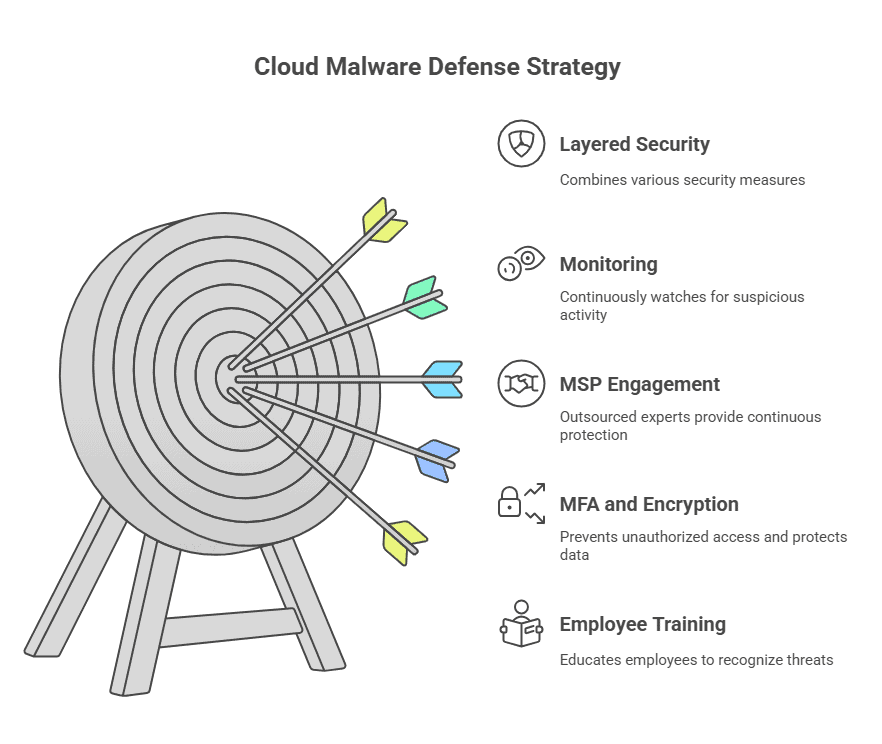
A solid defense against cloud malware uses multiple security layers. No single tool can fully protect your business. Managed Service Providers (MSPs) offer expert guidance and continuous monitoring to strengthen your defenses.
Start with multi-factor authentication (MFA) and encryption. These prevent unauthorized access and keep your data safe. Train employees regularly so they can recognize phishing and avoid risky behavior. Human error often opens doors to attackers.
Conduct frequent security assessments. This identifies vulnerabilities before attackers exploit them. Keep cloud software patched and updated to close weaknesses quickly. Use monitoring tools to watch cloud traffic and user activity. Early detection helps stop attacks before they cause harm.
- Engage MSPs: Outsourced experts continuously protect your cloud.
- Use layered security: Combine MFA, encryption, training, and patching.
- Monitor constantly: Watch for suspicious cloud activity 24/7.
These steps significantly reduce the risk and impact of cloud malware.
Key Cloud Malware Attack Prevention Technologies
This table highlights important technologies businesses should use to protect their cloud environments. Each technology plays a distinct role in stopping malware attacks or minimizing their impact.
| Technology | Purpose | How It Helps Prevent Cloud Malware Attacks |
| Cloud Access Security Broker (CASB) | Monitors cloud service usage and enforces security policies | Detects unusual user behavior and blocks risky activities before damage occurs |
| Endpoint Detection and Response (EDR) | Tracks activity on devices connecting to cloud services | Identifies malware infections early and isolates affected devices to prevent spread |
| Intrusion Detection and Prevention System (IDPS) | Monitors network traffic for malicious activity | Stops injection attacks and network-based malware by blocking harmful traffic |
| Cloud Workload Protection Platform (CWPP) | Secures workloads running in cloud environments | Protects virtual machines, containers, and serverless functions from malware |
| Identity and Access Management (IAM) | Manages user identities and access rights | Reduces credential bypass risks by enforcing strong authentication and least privilege |
| Data Loss Prevention (DLP) | Prevents sensitive data from leaving the cloud | Detects and blocks unauthorized data transfers caused by malware or insider threats |
| Security Information and Event Management (SIEM) | Collects and analyzes security data across cloud systems | Provides real-time alerts on malware activity and helps with incident response |
| Encryption Tools | Encrypts data at rest and in transit | Protects data from being read or altered if intercepted during cloud operations |
Leave Your Cloud Security to BASE Solutions
Cloud malware and cloud computing attacks put your business data and operations at serious risk. These threats evolve quickly and require constant vigilance to stay ahead. Ignoring them opens the door to stolen data, downtime, and customer distrust.
A proactive defense, backed by multi-factor authentication, employee training, strong encryption, and patch management, can help you stay secure. When a trusted MSP supports you, you’re not just reacting to attacks, you’re preventing them.
BASE Solutions offers 24/7 monitoring for your IT systems and a 15-minute or less response time for customer service, so your cloud is always secure.
Contact us now to schedule a consultation and see how BASE Solutions can protect your business before the next threat hits.